In this note

Banks & NBFCs that sell insurance alongside loans could see one of their richest fee streams shrink sharply. On 23 September 2026, IRDAI proposed capping the commission on life insurance packaged with a loan at just 2% of a single premium. Today, effective pay-outs on group credit life policies average around 45%, according to the regulator's own data. The same draft proposes nil commission on third-party motor cover for a new vehicle sold through a distribution entity.
The paper is called "Recalibrating Economics of Insurance Distribution". It is a consultation, not a final rule. But the direction is clear: the cost of the change falls on whoever sells the policy, not on whoever carries the risk.
first, who earns what in insurance?
Two different businesses sit inside every policy. The insurer underwrites: it collects the premium, carries the risk & pays the claims. The distributor sells: a bank branch, an NBFC, a broker, a web aggregator or an agent brings the customer in.
What is a commission here?
It is the slice of the premium that the insurer pays the distributor for bringing in the customer. The customer never sees a separate bill for it. It is built into the price of the policy.
That last point is the regulator's whole argument. IRDAI's paper says concentrated distribution "often results in higher commission pay-outs that are eventually embedded within product pricing". In plain words, the customer pays the commission without being told.
why is IRDAI doing this now?
The paper's evidence is striking. In life insurance, banks account for nearly Rs. 68,000 crore of sampled corporate agency premium, & pay-outs are significantly higher where a bank has tie-ups with several insurers than where it has just one.
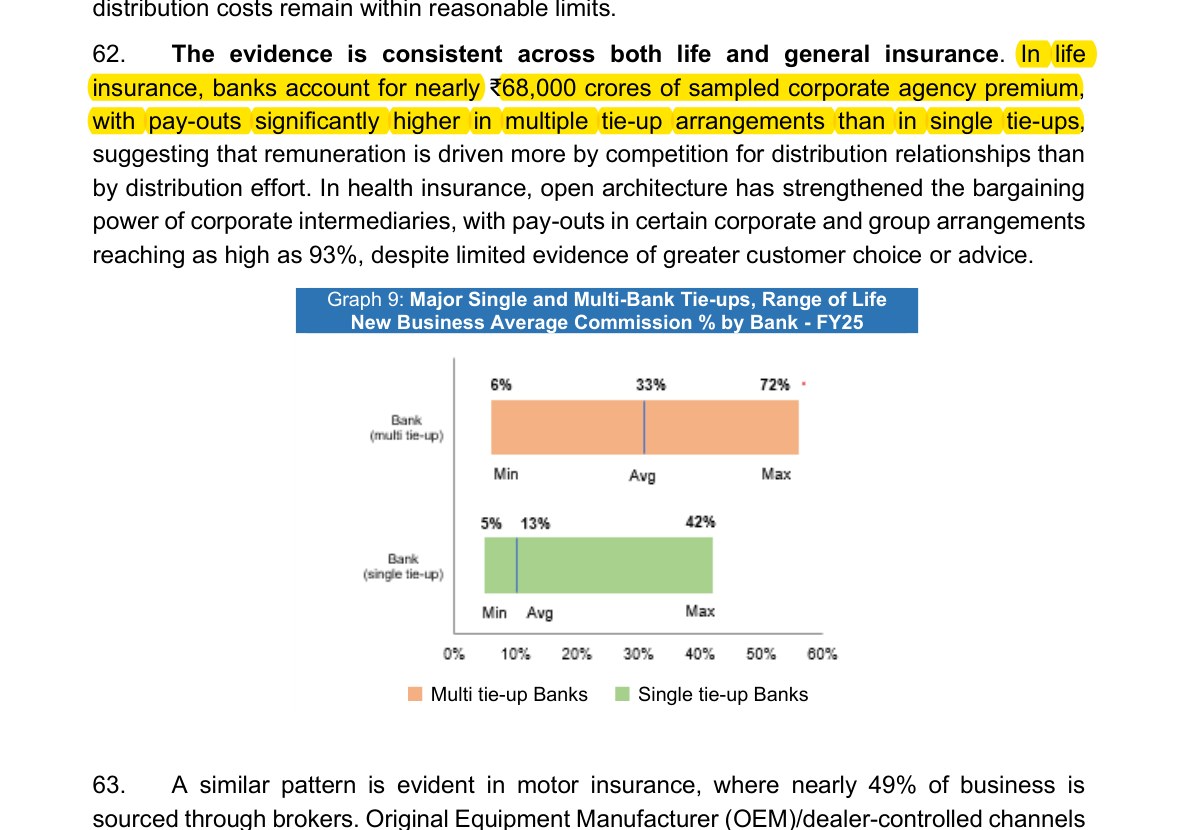
Why would more tie-ups mean higher commissions?
A bank with three insurer partners can let them compete for its shelf space. The insurer that pays more gets pushed harder at the branch. So, in the paper's words, remuneration is "driven more by competition for distribution relationships than by distribution effort". The seller's effort does not change. Only the price of access does.
The paper adds that distributor remuneration grew four to five times faster than premium between FY23 & FY25. The NBFC corporate agency channel has nearly tripled since FY23, with effective pay-outs averaging around 42% of new business premium.
what exactly is proposed?
The draft replaces one-size caps with limits by product, channel & selling effort. The loan-linked cases get the steepest cuts:
- Life insurance packaged with a loan: 2% of a single premium, whether individual or group.
- Motor insurance on a new vehicle, sold by a distribution entity: nil on third-party cover & 5% on own-damage cover.
- Individual health insurance sold by a distribution entity: 15% on a first-time policy & 5% on renewal.
- A ban on compulsory bundling of insurance with loans by banks & NBFCs, plus a ban on volume-linked incentives for their staff.
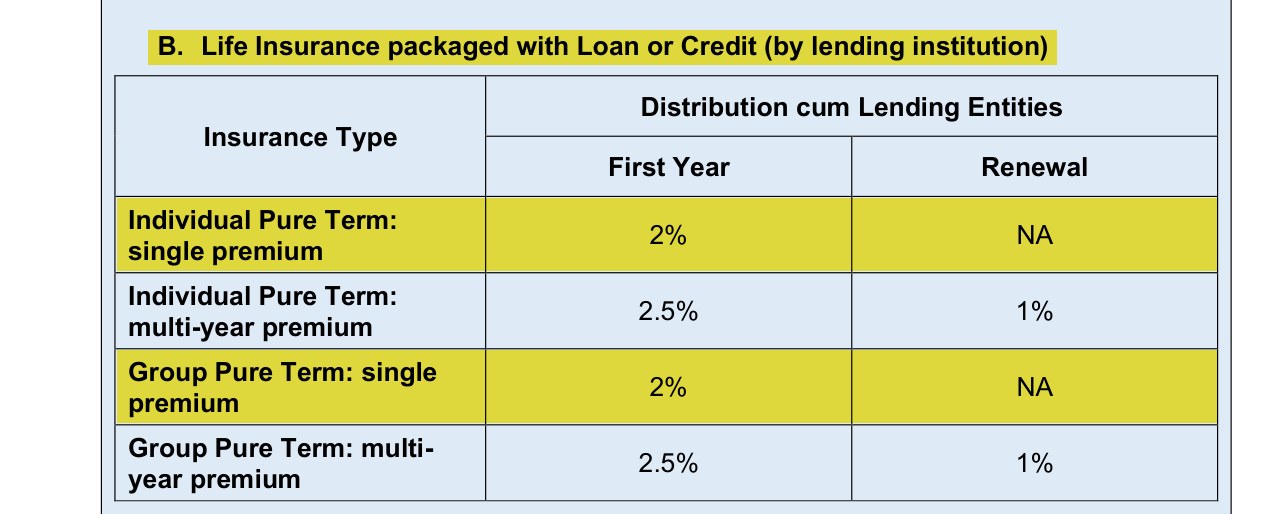
Walk the arithmetic on a loan-linked life policy. Say a borrower pays a single premium of Rs. 10,000 at the time of taking a loan. At a 45% pay-out, Rs. 4,500 of that goes to the lender as distribution income. At a 2% cap, it drops to Rs. 200. That is a fall of over 95% on the same policy, sold with the same effort.
Why does third-party motor cover get nil? The paper's logic is simple. A new vehicle cannot be registered without proof of this insurance, so nobody has to be persuaded to purchase it. The paper also notes that lenders insisting on bundled motor cover still earn around 16% commission while borrowers remain unaware.
The bundling ban may matter even more. If a lender wants to protect its loan book against a borrower's death, the paper says it can take a group policy & pay the premium as its own expense. That flips the economics: insurance moves from a fee the lender earns to a cost the lender bears.
the insurer's side: a cap on total expenses
What is expense of management?
It is everything an insurer spends to run the business, commissions included, measured as a share of premium. IRDAI proposes that a life insurer's limit fall to 15% of gross direct premium within two years & 12.5% within five, with FY2027-28 counted as year one. General insurers would move from 30% of gross written premium to 20% of domestic gross direct premium within five years.
Put that against a life insurer collecting Rs. 10,000 crore of premium a year. At 15%, it may spend up to Rs. 1,500 crore on everything. At 12.5%, that falls to Rs. 1,250 crore. Every rupee not spent on acquiring customers is a rupee that can stay with the insurer or flow back to policyholders.
so who absorbs the hit?
The pressure runs down the chain to whoever sells. Web aggregators & brokers, whose revenue is largely commission, are the most exposed. PB Fintech, which runs Policybazaar, told analysts the proposals look "quite extreme", with a large potential impact on general insurance & a smaller one on life.
Among lenders, analysts at Macquarie flag Axis Bank & HDFC Bank as more exposed than other large banks, because insurance fees form a bigger part of their fee income. Among NBFCs, JM Financial estimates insurance commission at roughly 26% of L&T Finance's FY26 profit before tax, so about a quarter of what the lender earned before tax came from selling policies. Piramal Finance has itself put the hit at 18 to 24 basis points of return on assets from FY28. What is return on assets? It is yearly profit divided by total assets. A basis point is a hundredth of a percentage point, so the hit is about 0.2 percentage points.
For insurers, the picture can improve. Lower acquisition costs mean better margins on the same premium. That is why several brokerages read the draft as good for underwriters even as distributors suffer.
the honest caveat
Commissions exist for a reason. Many people never go looking for a term plan or a health cover; someone has to sell it to them. If pay-outs shrink this far, some sellers may simply stop pushing low-ticket policies. So an insurer's margin can rise while its volume falls, & the paper cannot tell us which effect wins.
There's also the question of how much survives. Drafts this severe are often diluted after industry pushback. What the final norms keep of the bundling ban will likely matter more than any single percentage.
what's worth watching
- 25 October 2026: the last date for public comments on the paper.
- The final regulations, & how far the caps & the bundling ban are softened.
- 1 April 2027, the start of FY2027-28, which the paper treats as year one of the new expense glide path.
- September-quarter commentary from banks, NBFCs & insurance platforms on replacing lost fee income.
So if the seller earns less, does the customer pay less?
That is the test this reform has to pass. Whether premiums fall once the new norms apply is the number to check.
Educational analysis, not investment advice.