In this note
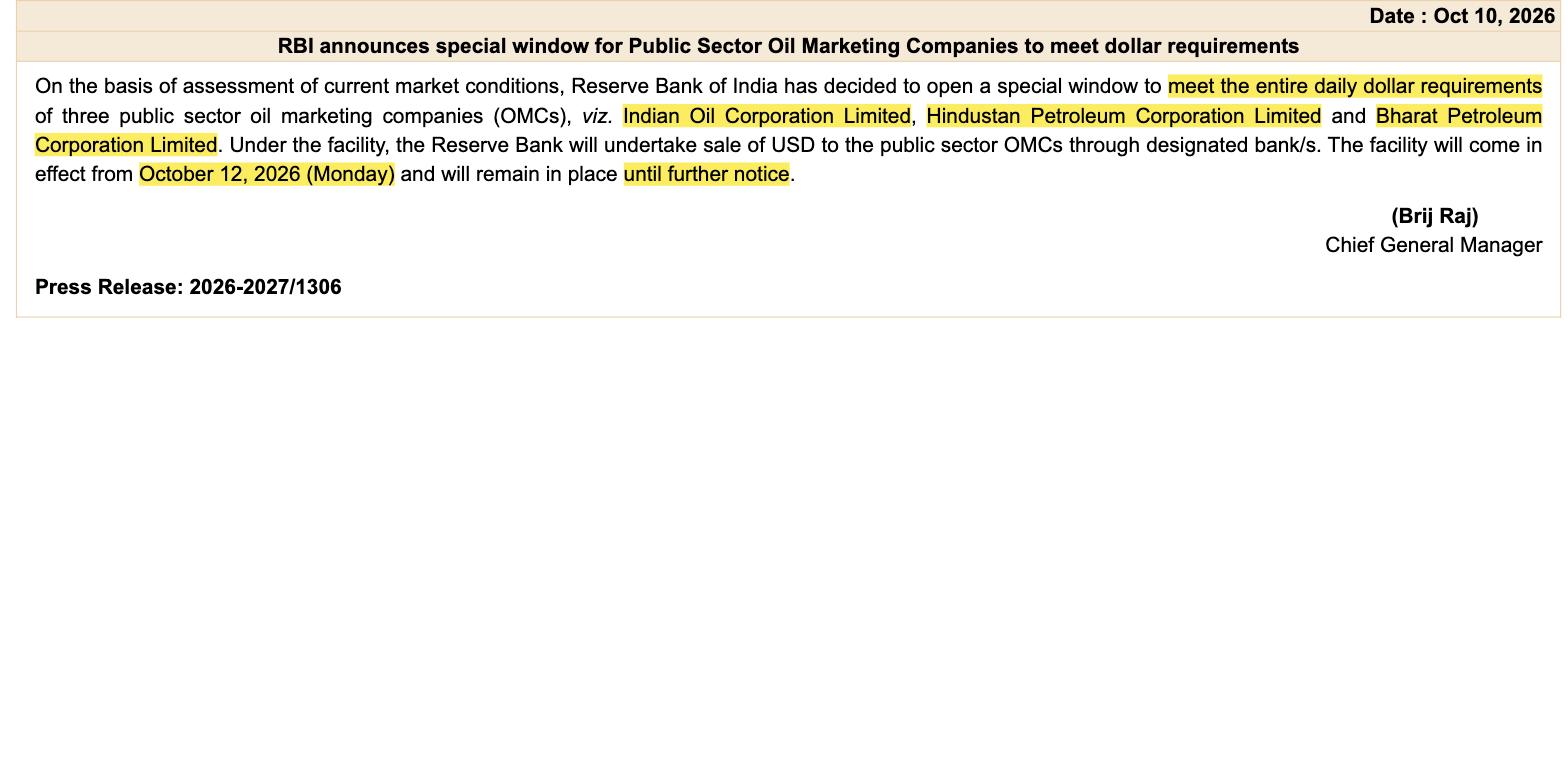
From Monday, 12 October, three companies stopped buying dollars in the open market. Indian Oil, Hindustan Petroleum & Bharat Petroleum now get their entire daily dollar needs straight from the Reserve Bank of India. These three are among the biggest dollar buyers in the country, because India imports most of its crude oil & pays for it in dollars. Taking them out of the market is the RBI's clearest signal yet that it wants to cut demand for dollars, not just supply more of them.
The oil window came with a second package. On 10 October, the RBI also tightened the rules on currency hedging for everyone else. Both arrived three days after the RBI raised the repo rate by 0.25 percentage points to 5.50%, its first hike in nearly four years.
Why does the RBI care who buys dollars?
Start with what the RBI is defending. India's foreign exchange reserves stood at $734.6 billion on 2 October. They fell by about $13 billion in that single week. Over four weeks, they fell by roughly $51 billion from a peak of $785.7 billion in early September.
What are forex reserves?
They are the dollars, other currencies & gold the RBI holds so that India can pay for imports & settle foreign debt even when money is flowing out. When the rupee weakens too fast, the RBI sells some of these dollars to calm the market. That is mostly why reserves have been falling.
The pressure comes from two directions. Crude oil has been above $100 a barrel, so every barrel India imports needs more dollars. & foreign portfolio investors pulled out a net $10.3 billion between April & 5 October, according to the RBI. More dollars going out, fewer coming in. The rupee weakens.
What does the oil window actually change?
Before Monday, the oil companies bought their dollars from banks every day, in the same market as everyone else. A large, predictable daily buyer pushes the price of the dollar up. Now the RBI sells them dollars directly, through designated banks.
Notice what does not change. The dollars still leave India's reserves, because the oil still has to be paid for. What changes is the route. The demand no longer shows up in the open market, so it no longer moves the exchange rate on the day.
For the three companies, this means they no longer compete with every other importer for dollars on a volatile day. The RBI has said the window stays open "until further notice".
What changed for everyone else?
What is a currency hedge?
It is a contract that fixes today the exchange rate for a dollar payment due on a future date, so a swing in the rupee cannot wreck a company's costs. An importer paying $10 million in three months might lock in the rate now. The bank that writes the contract is called an authorised dealer, which simply means a bank licensed by the RBI to deal in foreign currency.
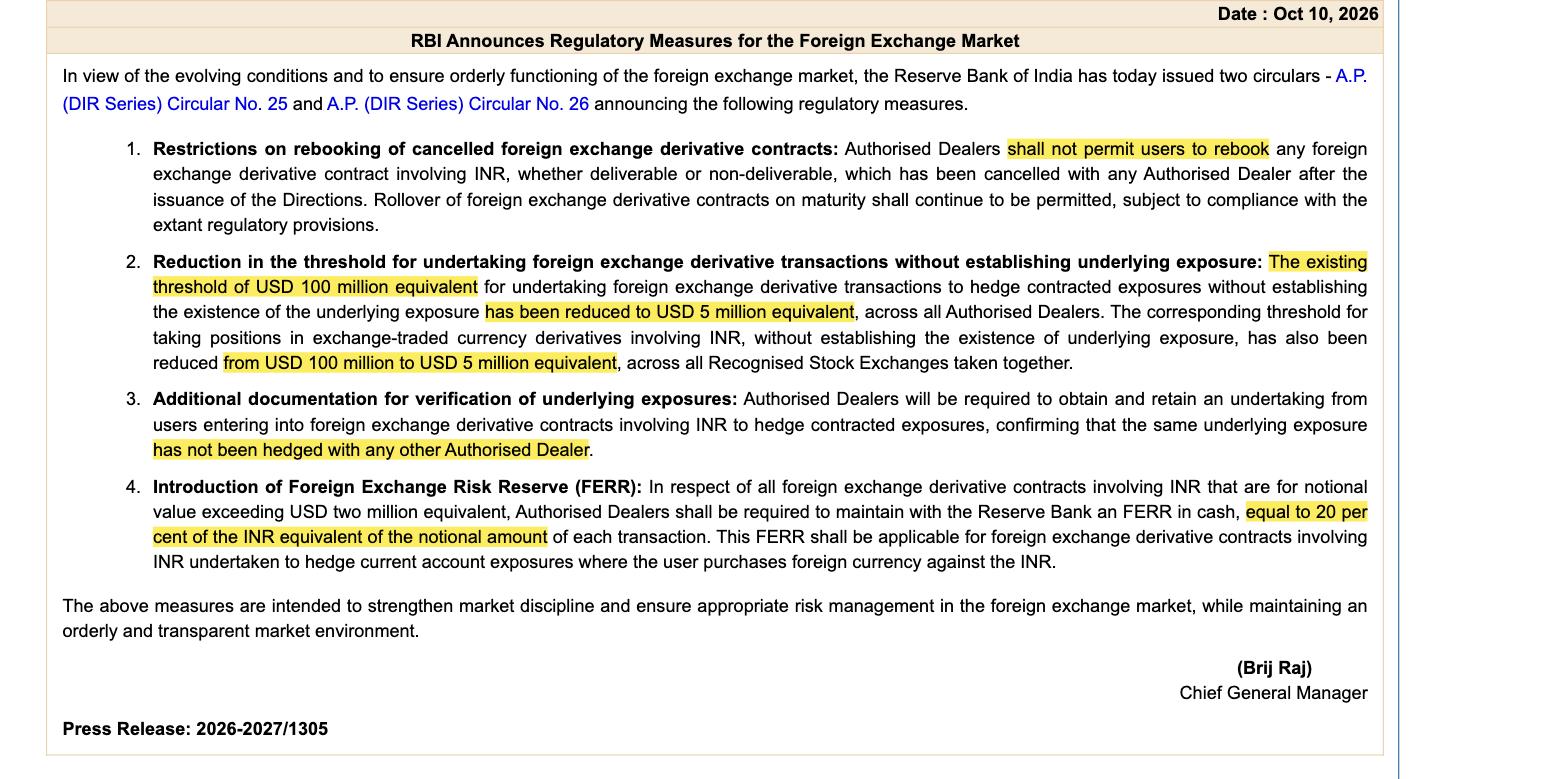
The RBI changed four things.
- If a company cancels a rupee hedge, it cannot book a fresh one in its place. Rolling a contract over when it matures is still allowed.
- Companies could hedge up to $100 million without first proving a real underlying exposure, meaning an actual import bill or export receipt. That limit is now $5 million. The same cut applies to rupee currency futures & options on the stock exchanges, taken together.
- A company must confirm in writing that it has not hedged the same exposure with another bank.
- Banks must keep a new cash reserve with the RBI on some hedges. This one carries a real cost.
So the room to take currency positions without paperwork has shrunk by 95%. That is aimed at speculation, meaning bets on the rupee's direction rather than protection for real trade.
What does the 20% reserve cost?
What is the Foreign Exchange Risk Reserve?
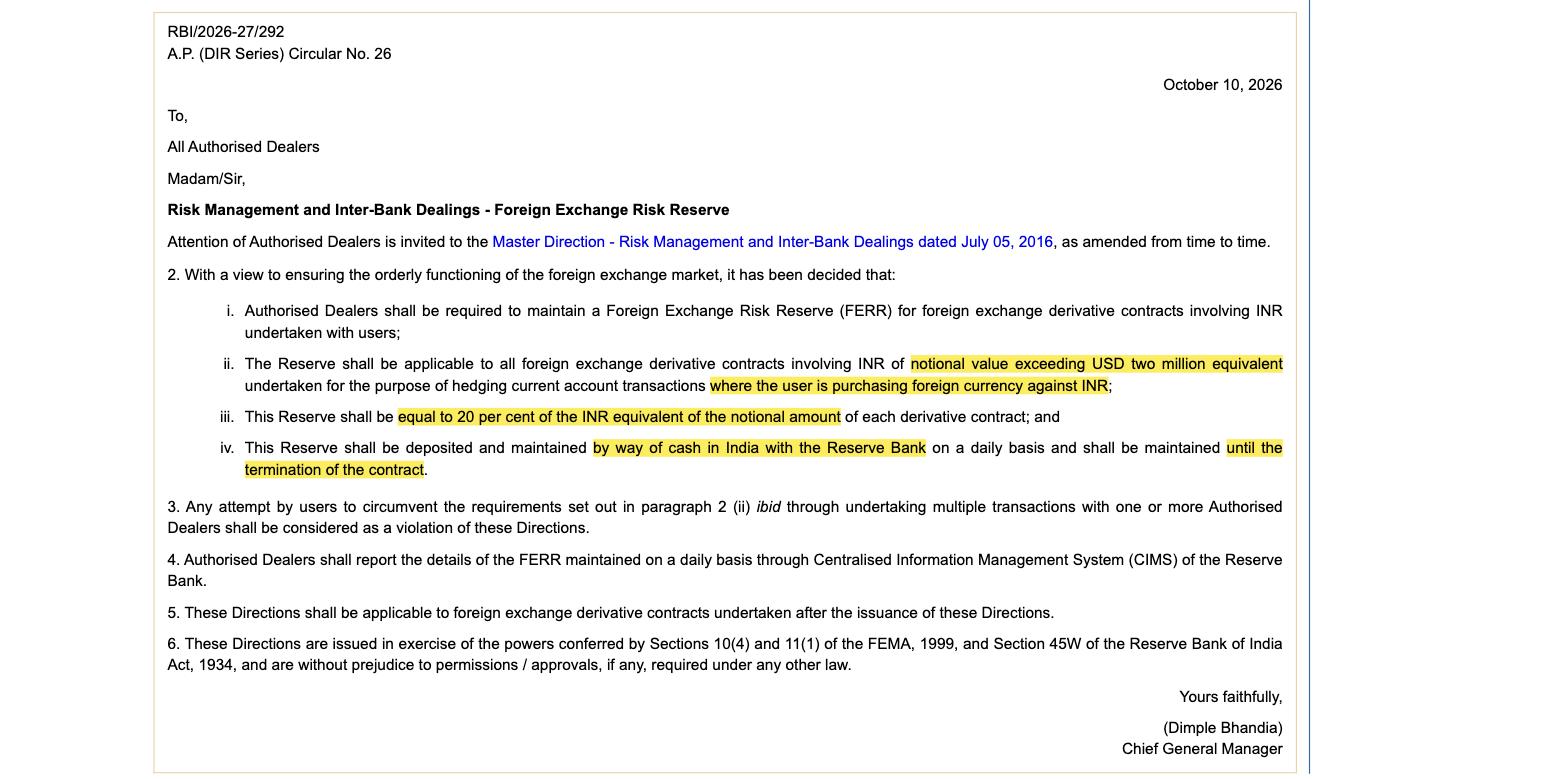
It is cash that banks must park with the RBI whenever they write a rupee hedge above $2 million for a customer who is buying foreign currency to pay for current account items such as imports. The reserve is 20% of the rupee value of the contract, & it stays with the RBI until the contract ends.
Walk through an example. Say an importer hedges a $10 million payment due in three months. Assume, for round numbers, Rs. 96 to the dollar. The contract is worth Rs. 96 crore. Twenty per cent of that is Rs. 19.2 crore, which the bank must hand to the RBI in cash for three months.
Now suppose that cash earns nothing. The circular does not say whether it does. The bank gives up what it could have earned on Rs. 19.2 crore. At the 5.50% repo rate, three months of that is about Rs. 26 lakh. Against a Rs. 96 crore contract, that is a little under 0.3% of the hedge's value. If banks pass it on, hedging dollar purchases simply got dearer. Exporters, who receive dollars, do not trigger the reserve at all.
Who feels this?
- The three oil marketing companies get steadier access to dollars, & their daily buying no longer shows up in the market.
- Importers hedging more than $2 million may pay more to hedge if banks pass on the reserve cost.
- Banks give up some income, because cash locked with the RBI cannot be lent.
- NSE & BSE run rupee currency futures & options. A $5 million cap without proof of exposure could shrink trading there.
What is the other side of the coin?
These measures change how dollars are bought. They do not change how many dollars India needs. The oil companies' demand is still met from reserves, so the reserves still fall. If oil stays high & foreign money keeps leaving, the pressure on the rupee stays too, only routed through the RBI instead of the market.
Rules built to stop speculators also add paperwork & cost for the importer who simply wants certainty. These are emergency tools, & the open question is how long they stay.
What's worth watching from here?
- Every Friday, the RBI publishes the weekly reserves figure. The next releases show how much the oil window draws on reserves.
- India's September trade data, due from the Commerce Ministry in mid-October. A wider oil import bill means more dollar demand.
- Whether the RBI clarifies if the 20% reserve earns any interest. That decides how much hedging really costs.
- The quarterly results of the three oil companies & the banks with large forex desks, for any comment on these rules.
Educational analysis, not investment advice.